

What size mini split a Vermont home needs

Send the form and the search for an installer is over.

Send my request

What size mini split do I need for my Vermont home?

You want a straight answer before anyone comes out to look at the place. Sizing a mini split isn't just square footage, and most homeowners know enough to be wary of a guess that ignores how the house actually performs. You want to know what actually goes into the number, so that whatever gets installed keeps up on the coldest night without running up the power bill the rest of the year.

It depends on square footage, insulation, and your oil furnace's role in the plan

There's no single BTU number that fits every Vermont home. A tight, well-insulated room needs less capacity than an old farmhouse wall with little insulation behind it. Ceiling height, window count, and how many rooms the system has to reach all factor in too. Most homes here heat with oil, and a lot of homeowners size the mini split to carry the shoulder seasons and mild winter days, letting the oil furnace handle the coldest stretches. That changes the math from a system trying to be the only heat source. A contractor measures the actual space and checks the insulation before settling on a unit, since a system that's too big or too small wastes money either way on power rates that are already high here.

A white wall-mounted mini-split indoor unit on a beige interior wall, with a potted leafy plant at the left and a curtain edge at the right.

Sized right

A mini split that matches your house holds a steady temperature without the compressor kicking on and off all day. It runs long, slow cycles, pulls the moisture out of the air, and the wall by the curtain stays quiet enough that you forget it's there.


A dusty, discolored wall-mounted mini-split air conditioner indoor unit near the top of a plain light-colored interior wall below a white molding strip.

Sized wrong

An undersized unit never catches up on the hottest days, and an oversized one cools the room fast then shuts off before it's pulled the moisture out, leaving the air clammy. Either way the unit short cycles, and dust builds up across the casing and vents faster than it should.

Why does one room never feel right?

If the unit is too big for the room, it cools fast and shuts off before it pulls the damp out of the air, so the room feels clammy even at the temperature you set. If it's too small, it runs flat out all afternoon and still can't catch up on the warmer days, and in January it can't carry the room at all once the oil furnace isn't doing the work it used to in that space. You'll hear it too, the compressor cycling on and off instead of settling into one long, quiet run. A unit fighting its size all year also wears down faster than one sized to the room.

A man in a gray sweater reclines in a brown leather armchair with his eyes closed, beside a wooden side table holding a mug, a folded newspaper and a potted plant, with a bookshelf and sunlit window behind him.
A man with greying hair and a dark sweater leans back on an armchair with his eyes closed and a slight smile, in a living room with a bookshelf, plant, folded newspaper and mug on a wooden table.
A man in a gray fleece jacket sits reclined in a leather chair with his eyes closed, in a room with bookshelves, a table lamp, a window, and a desk holding a folded newspaper and a dark mug.
A bearded man in a gray fleece pullover sits with eyes closed in a brown leather armchair in a living room, with a floor lamp, bookshelf, potted plants, a side table holding newspapers and a dark mug, and a bright window behind him.

Why oil heat changes the sizing

Most Vermont homes run on oil, and a mini split sized for cooling alone often comes up short for the heat side. Cold climate heat pumps are rated for how much heat they still put out at low outdoor temperatures, not just at 47 degrees. A contractor doing the load calculation has to check that rating against your coldest nights, not just the square footage of the room. Undersize that part and the unit leans harder on the oil furnace all winter, which defeats the point of adding it. Get it right and the mini split can carry most of the heating load on its own, with the furnace stepping in only when it's truly cold.

Electricity costs make the math matter

Power here runs expensive, so an oversized or undersized unit shows up on the bill faster than it would somewhere with cheaper rates. A unit that's too big cycles on and off instead of running the long, steady stretches that use less electricity per hour. A unit that's too small runs flat out trying to catch up, which also costs more over a billing cycle. A proper load calculation, done room by room, is what keeps the compressor running the way it's designed to. That calculation is also the reason a flat answer based on square footage alone can't tell you what your home actually needs.

Power costs 22.79 cents per kilowatt-hour statewide

At that rate, an oversized unit cycling on and off, or an undersized one running flat out, shows up fast on your bill. Getting the size right the first time is what keeps it from costing you all winter.

EIA-861 2025 statewide residential average

A white wall-mounted mini-split air conditioner indoor unit with visible dust and discoloration, installed near the ceiling on a plain beige wall.
Before you get your mini split installation
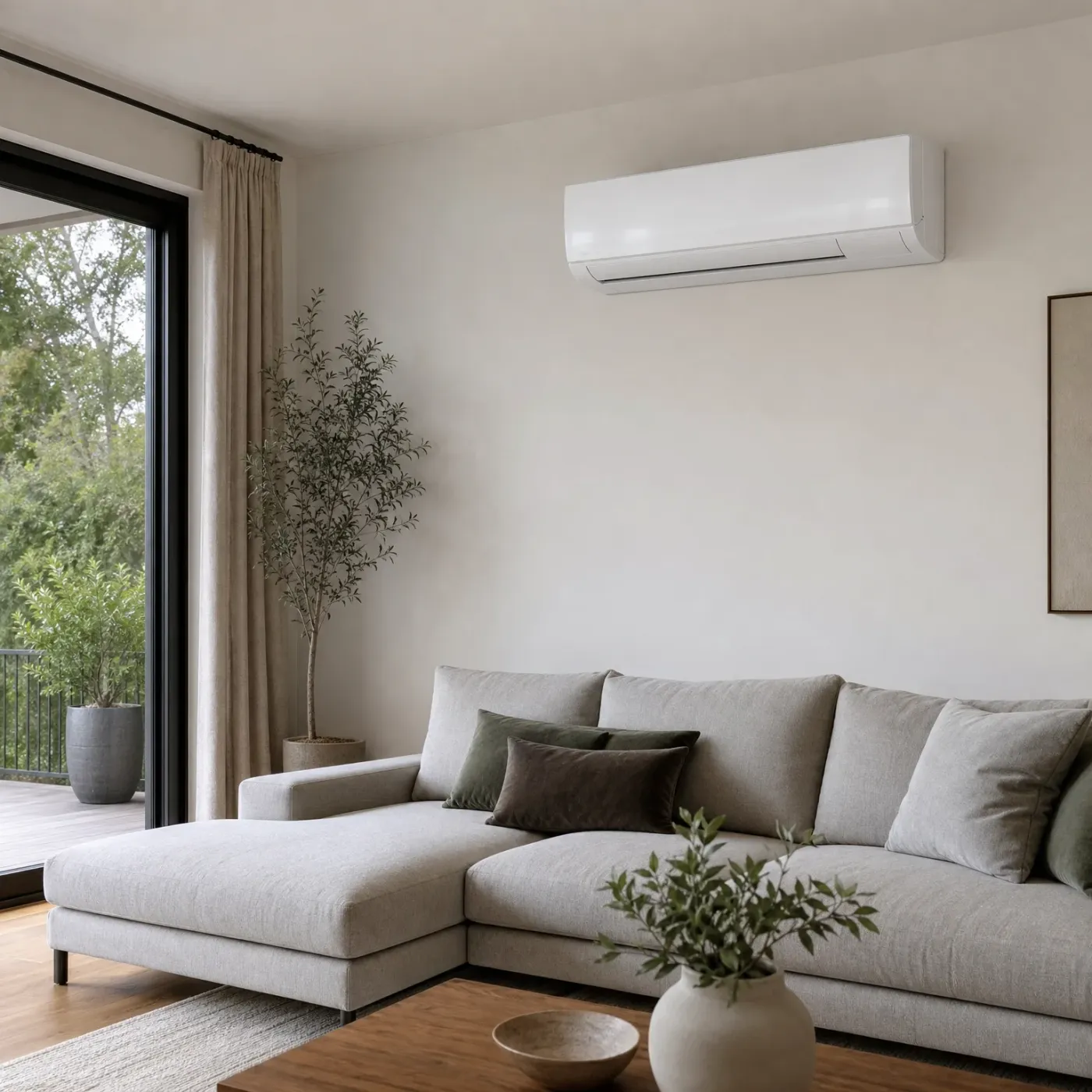
A white wall-mounted mini-split air conditioner installed high on a beige interior wall near the ceiling, with a sheer curtain and window at the left edge.
After you get your mini split installation
Living room with a grey sectional sofa, wall-mounted white mini-split air conditioner above it, a potted tree beside sliding glass doors with beige curtains, and a wooden coffee table with a vase of foliage in the foreground.

Stop chasing a mini split pro

Describe the project once instead of to every installer.

After this form, you can stop searching for a mini split pro.

Fill out one form

No fee to send it, and nothing to sign.

One Zone or Several

One zone

  • Covers a single room or open living area, so the main living space gets even heat and cooling off one head.
  • Costs less to install than a multi-zone system since there's one indoor head and one line set to run.
  • Leaves rooms outside that zone dependent on your oil heat and whatever window units or fans you already have.
  • Easier to size right, since the contractor is matching one head to one load instead of balancing several.
  • If you add zones later, you're paying for a second installation instead of planning the whole house at once.

Multi-zone

  • Puts a head in each room you want covered, so bedrooms and living space can each run at their own setting.
  • One outdoor unit serves several indoor heads, which means less equipment sitting outside the house.
  • Sizing gets more involved, since the outdoor unit has to be matched to the combined load of every zone running at once.
  • Costs more upfront than a single zone, with more line set and more indoor heads to install.
  • Lets you shut off a zone you're not using, which matters more with Vermont power rates than it would elsewhere.
A white wall-mounted mini-split air conditioner installed high on a beige interior wall below crown molding, with a sheer white curtain on a dark rod at the left edge.

Running clean

This is what a correctly sized unit looks like on the wall after a season of use. The casing stays clean because the fan and coil aren't straining to keep up, and air moves through without picking up the dust that builds when a system runs harder than it should.

A dusty white wall-mounted mini-split air conditioner unit installed near the ceiling on a plain light-colored interior wall, with a small recessed ceiling fixture at upper left.

Running dirty

Grime like this builds when a unit works too hard for too long, pulling more air through the coil than a clean filter and a normal cycle would call for. By the time you can see it on the casing, it's been working that way for a while.

A closed silver laptop and a ceramic mug of dark coffee sit on a wooden table in front of two chair backs, with a kitchen counter, tiled backsplash, wooden cutting boards, a vase of greenery and a potted plant by a window behind.

The right size comes from a load calculation, not a guess

A mini split sized for your Vermont home accounts for the square footage, the insulation, the windows, and how far the temperature drops on a January night. Get that number right and the unit runs long, steady cycles instead of straining or short-cycling, and it carries its share of the heat load alongside your oil system instead of leaving a room cold.

You could spend the next few weeks calling around, explaining your house to one contractor after another, and comparing quotes that size things differently. Or you could send the form and skip that part. Once it's in, the job of finding someone qualified to size and install the unit is no longer yours to carry.

Interior corner of a living room with a beige upholstered sofa and dark cushion in the foreground, a ceramic vase of leafy branches on a dark side table by a curtained window, a framed picture on the wall, and a wood-surround fireplace at right.
A gray-haired man with a beard in a blue button-placket shirt reclines on a couch with his eyes closed, beside a sunlit window with a green plant.
A woman in a cream knit sweater sits in an armchair with her eyes closed near a window showing yellow autumn foliage, with a mug on a round wooden side table beside her.

Mini Split Installation

Send one request and you're done looking

Answer a few questions instead of calling shop after shop.

A black-framed smartphone standing upright against a plain white background, its screen filled with solid green.
Step 1 of 3: Equipment